
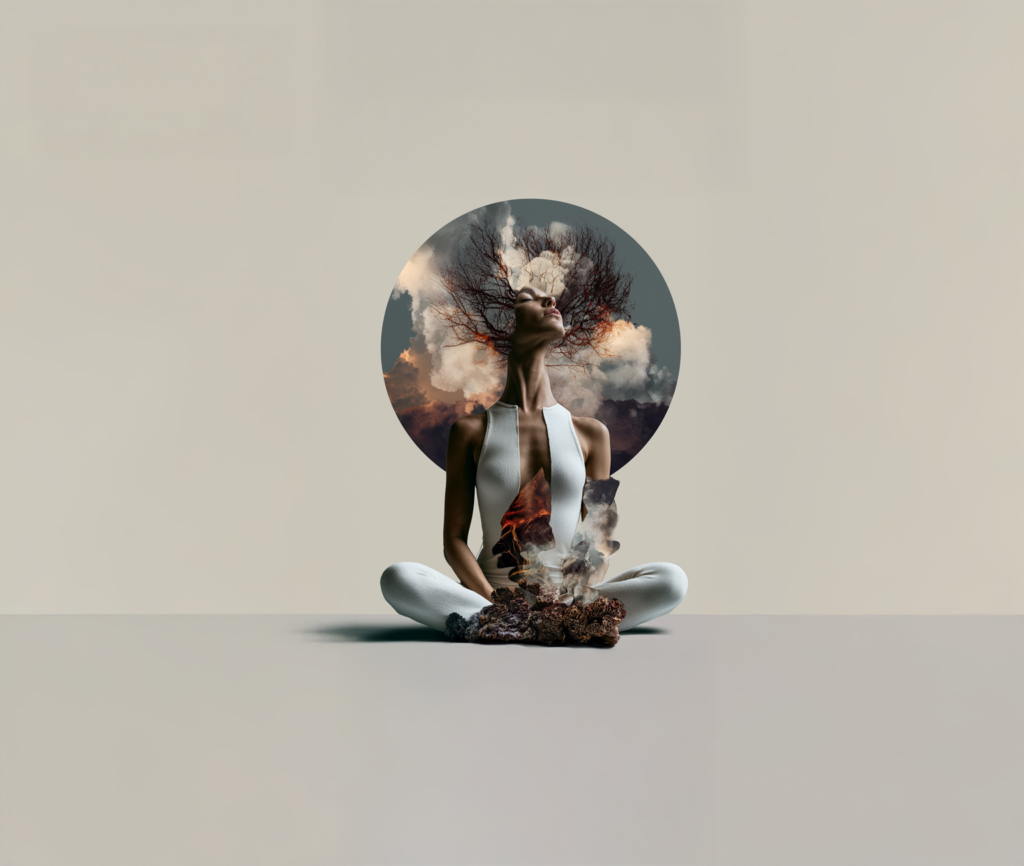


The news cycle refreshes itself before you’ve finished your coffee. The feed scrolls before you’ve finished a thought. Somewhere between the headline and the next headline, the body absorbs what the mind hasn’t had time to process.
Political strategists have a name for this. They call it flooding the zone: the deliberate production of so much information, so much outrage, so much urgency, that attention itself becomes the casualty. People stop asking what matters and start simply trying to keep up.
What gets lost in that exchange is not just clarity. It’s a regulation. Overwhelm is not only happening in the mind. It is happening, moment by moment, in the nervous system.
When Information Becomes a Threat
The body was never built to metabolize an infinite scroll. It was built to respond to a threat, resolve it, and return to rest. When uncertainty arrives without resolution, again and again, the body answers the only way it knows how: survival mode, sustained indefinitely.
Thoughts begin to race. Attention narrows to a point. Breath shortens. Muscles brace for impact that never quite lands. Sleep frays at the edges. And underneath it all, the mind develops a quiet, exhausting habit: scanning for danger long after the danger has passed, or never properly identifying what it was in the first place.
The instinct, understandably, is to reach for more information, as if the next headline might finally deliver the certainty the last one withheld. But the nervous system isn’t asking for more input. It’s asking for presence.
This is the work of Primal Somatics.
The Cost of Living in Permanent Reaction
At the center of Primal Somatics sits a simple, radical premise: awareness is what makes choice possible. Without it, the body simply reacts, automatically, repeatedly, to whatever arrives next.
Left unchecked, the nervous system begins to treat every new piece of information as an emergency requiring immediate response. Picture a tennis ball machine left running long after the player has walked off the court. The balls keep firing. The body keeps flinching. The cycle doesn’t stop because nothing told it to.
What follows is a particular kind of exhaustion: carrying tension that was never yours to hold, rehearsing outcomes that haven’t happened, bracing for a future the body has already decided is dangerous. The body settles into a permanent state of readiness. Always prepared. Never at rest.
The Missing Skill: Returning to the Present
Primal Somatics offers something almost deceptively simple: change the relationship with the body before attempting to change the thoughts.
Rather than asking what should I do about all of this, the more useful question is quieter: what is happening in my body, right now?
The shoulders. The jaw. The breath. The quality of contact between the feet and the ground.
This isn’t a call to look away from what’s real. It’s an invitation to remain connected to yourself while you face it, which is precisely what allows new patterns, new neural pathways, room to form.
A Somatic Reset, in Real Time
The next time the cycle starts to flood the zone, pause. A few seconds is enough.
Notice the floor beneath your feet. Let the eyes soften, rather than fix. Notice the breath without trying to correct it.
Then ask one question, and ask it precisely: In this moment, am I safe?
Not tomorrow. Not next month. Not according to the headline still open in another tab. In this moment, alone.
The nervous system only ever responds to now. Which means now is the only place perception can actually be shaped.
Presence Is Not the Same as Avoidance
A regulated nervous system is sometimes mistaken for a disengaged one. It isn’t.
Regulation is what allows a person to respond with intention instead of reacting on impulse. It makes room for awareness, for advocacy, for action that holds up over time. A regulated system can meet the world without being consumed by it. A dysregulated one tends to oscillate between panic and shutdown, two states that look like opposites and produce the same result: depletion.
One sustains. The other empties out.
The Quiet Radicalism of Staying Connected
The information will keep coming. That much is certain. The only real variable is whether awareness can stay louder than the noise insisting otherwise.
Primal Somatics holds a position that runs against the current: that safety, clarity, and discernment were never going to be found in the next piece of information. They were already here, inside the body, waiting to be returned to.
A regulated nervous system doesn’t silence the world. It simply stops letting the world choose for you. Peace, in that sense, is not the absence of noise. It’s the presence of self, even inside it.
Practicing This, Together
Reading about regulation is a beginning. Practicing it, in real time, alongside others who understand the weight of holding it all, is what makes it durable.
soma.soul.shift offers two paths back to the body: small group sessions for ongoing, in-community practice, and aligning with immersive retreat programs for those retreats who are ready to help their guests step fully away and reset.
